
Key Takeaways
- Asphalt shingles describe a steep-slope roof-covering family, not one uniform product.
- Profile and granules set the roof’s visual character and surface texture.
- Roof geometry and weather create the broader system context around the shingles.
- A visible clue or a reported storm does not, by itself, establish source, condition, or scope.
What Asphalt Shingles Are
A steep-slope roof-covering family
Asphalt shingles appear on steep-slope roofs in many forms. They share a layered build and a granule-faced surface, yet the family includes profiles that vary in shape, scale, depth, and how courses present on a plane. Some roofs read as flat and uniform; others show layered, dimensional relief. Two houses can both carry asphalt shingles and still look markedly different from the street because profiles, patterns, and scale vary within the family.
Common threads include an asphalt-coated reinforcement and a ceramic-coated mineral granule surface that creates the color and texture people see. Beyond that, profiles diverge. Treating asphalt shingle as a family name keeps expectations straight: the label alone does not reveal which profile is present, how the surface looks up close, or how the roof reads from plane to plane. Those details come from the specific shingle category paired with the geometry it covers.
The shingle roof as a connected system
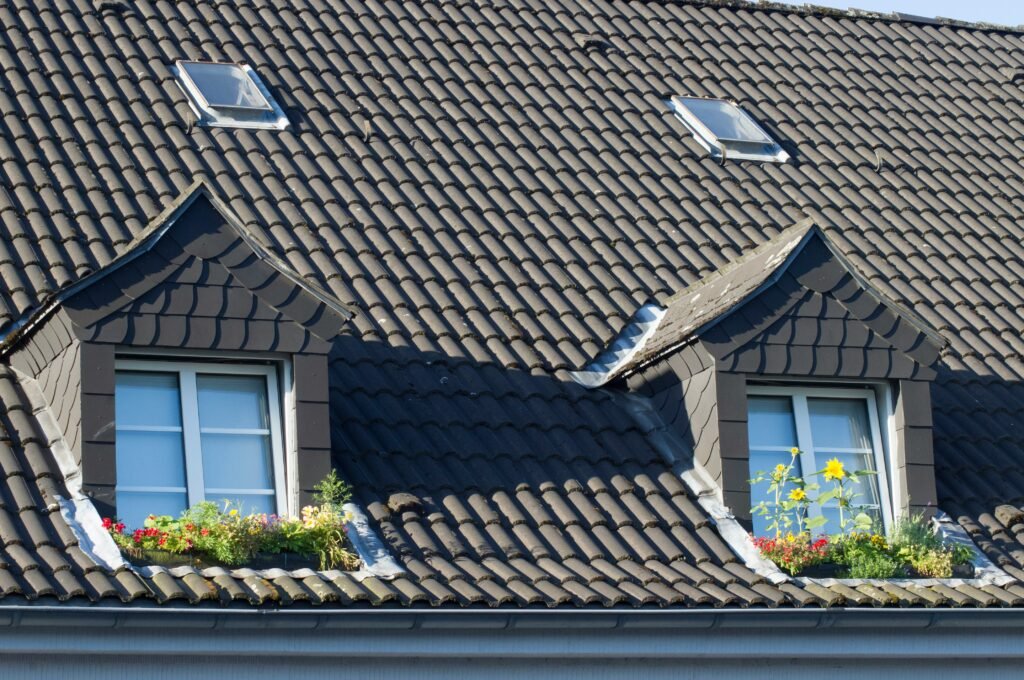
A shingle-clad roof functions as one connected system. The roof deck, the alignment of courses, and the places where planes and materials meet all shape what the surface looks like. Ridges and hips form high lines where planes converge. Valleys gather water, bend shadows, and redirect sightlines. Eaves and rakes frame the field, while dormers, skylights, chimneys, and walls interrupt or turn course lines and shift how patterns appear from common viewpoints.
That system context matters whenever one plane is compared with another. Sun angle, orientation, and nearby elements cause colors and textures to present differently through the day and season. Overhanging trees, gutters, and neighboring buildings influence weathering and how observers perceive the surface. Thinking of the roof as one system spanning its planes and transitions offers a sound framework for interpreting what is visible at any specific spot.
Why appearance and whole-roof context should be separated
A roof’s appearance offers clues about profile and pattern, yet appearance alone is not the whole story. A uniform grid often signals a strip or three-tab profile, while staggered, layered shadows align with laminated designs. Even so, what you see always sits inside a broader frame that includes roof shape, plane count and orientation, the presence of valleys or wall interfaces, and the building’s surroundings. Lighting and vantage point can make the same surface read very differently.
Separating visible traits from whole-roof context prevents overreach. A dark streak, a lighter patch, or a scuffed-looking area does not, on its own, establish a source or a scope. Weather reports are useful prompts, but a reported storm is not an answer by itself. Professional evaluations weigh the entire roofing system and distinguish ordinary aging and everyday weathering from event-related change. Treat what is seen as input, not a final conclusion.
Common Asphalt Shingle Types
Strip and three-tab shingles
Strip shingles present as a single-layer field across a roof plane. The familiar three-tab variant uses evenly spaced cutouts that produce three rectangular tabs per piece. From the street, three-tab roofs form a steady, repeating grid with a relatively flat profile and a pattern of horizontal courses punctuated by vertical tab cutouts.
The three-tab look reads as simple and regular. Shadow lines come mostly from the single-layer thickness and the tab geometry rather than stacked layers. Even with color variation in the granules, the overall profile remains even and orderly, creating a clean, measured rhythm on long runs as well as on smaller planes.
Laminated or architectural shingles
Laminated, architectural, or dimensional shingles combine multiple layers to create a thicker, more varied face. Portions cut from an upper layer adhere to a base layer, producing staggered edges and areas of depth. On the roof, this structure throws stronger shadows and softens the grid, yielding a sculpted look that can mimic deeper textures. Course lines remain legible, while varied cutouts reduce repetition.
From a curbside view, laminated shingles deliver more relief and visual complexity. Their layered edges intensify shadows that shift with sun angle, time of day, and viewpoint. Color blends can heighten that sense of depth, so the roof reads as more textured and dynamic than a flat, single-layer profile.
Interlocking shingles
Interlocking shingles create a tight, uniform surface with squared or similarly regular exposures. The joining detail is not visible from the ground, yet the finished pattern often looks crisp and consistent, reading as tidy lines across a plane.
The impression is one of coherent alignment with fewer pronounced shadow lines than many laminated designs. On long, open stretches, the pattern can appear especially orderly, emphasizing straight runs and consistent spacing.
Large individual shingles and other visual profiles
Some asphalt shingles are made as larger individual units rather than narrow strips, creating wider or taller exposures on the roof. The visual result is a bolder scale with fewer vertical interruptions and longer horizontal lines. Other designs alter cut shapes to create distinctive outlines that change the roof’s rhythm.
These profiles influence how the roof reads from a distance. Larger faces make granule color blends and shading transitions more visible within each piece, so broad areas of tone may shift as light moves, even when the underlying profile stays consistent.
Fiberglass reinforcement and asphalt coating context
Asphalt shingles typically combine a reinforcement mat, an asphalt coating, and a ceramic-coated mineral granule surface. Many current products use fiberglass reinforcement to support the asphalt and help hold granules in place. The granules supply visible color and texture and serve as a protective top layer. The reinforcement is concealed in the finished roof, yet it supports how the surface performs and ages.
For a typical observer, the visible elements are the profile of the pieces, the course pattern, and the granule-covered face. The layers beneath influence how the roof interacts with its environment over time, while the eye mostly reads a profile’s silhouette, shadow lines, and the color blend created by the granules.
Surface Features That Shape the Look of a Shingle Roof
Mineral granules, color, and texture
Ceramic-coated mineral granules define the exposed surface of asphalt shingles. At close range, they appear as embedded colored particles; at roof scale, they blend into a field of color and texture. Granule mixes may be uniform or intentionally variegated to create depth and tonal movement across the surface.
Granules also help shield the asphalt from ultraviolet exposure. That benefit belongs to material context rather than something easily judged by sight. Two roofs that look very similar may use different granule blends. Color and distribution affect how the surface interacts with sunlight, shaping which wavelengths are reflected or absorbed and how the roof reads in bright sun compared with diffuse light.
Tabs, cutouts, layers, and shadow lines
Shingle faces can include cutouts, tabs, and stacked sections that break up the surface visually. Three-tab designs emphasize equal-width tabs for a steady beat across each course. Laminated profiles introduce irregular edges and multiple layers that cast stronger shadows and reduce repetition. Interlocking and larger-format units rely on continuous edges or broader faces for restrained interruptions and clean lines.
Shadow lines drive depth perception. Thicker or layered sections throw distinct shadows that wander with the sun, while flatter profiles show subtler shading. The same roof can look different on a bright afternoon than on an overcast morning as layer depth and granule color interact with available light.
Shading variation and surface reflectance
Not every color variation signals aging or damage. Many blends are engineered for tonal movement within and between courses so individual pieces cohere at distance. Short-term visual differences may also arise during manufacturing or handling, such as temporary transfer from back-surfacing, which can diminish as the surface weathers.
Solar reflectance describes the share of sunlight a surface reflects rather than absorbs. Work on cool-colored roofing focuses on granule pigments and surface designs that raise reflectance without changing familiar hues. Two similar-looking roofs can differ in how much sunlight they reflect. For most discussions, reflectance belongs to energy context rather than visual diagnosis, and perceived brightness is not a precise gauge of reflectance.
Algae discoloration and other non-diagnostic appearance changes
In many climates, algae can create brown-to-black discoloration or streaks on shingle surfaces, especially on lighter colors. This effect is mostly aesthetic rather than an indicator of structural harm to the shingle. Other non-diagnostic variations, including uneven shading from granule blends or subtle shifts between production runs, can change the look without signaling a functional issue.
Because multiple influences shape appearance, visible discoloration should be treated as context. A change in tone, streaking, or a contrasting patch does not, on its own, identify a source, confirm a condition, or determine scope.
How Geometry and Weather Shape the Conversation
Roof shape, slope, and visible profile
Roof geometry sets the stage for how a shingle surface is perceived. Steep-slope configurations include gables, hips, and combinations with dormers and intersecting planes. Slope controls how much of a plane is visible and how strongly course exposure reads. A steep front gable shows more face and accentuates course lines, while a shallower plane compresses apparent pattern and depth.
The same shingle can present differently on a complex roof. A south-facing slope may appear brighter at noon; a north-facing dormer can look cooler and flatter. Long, straight runs emphasize regularity, while short or intricate planes break up rhythm. These geometry effects operate independently of condition, yet they shape how the surface reads from common vantage points.
Ridges, valleys, eaves, rakes, wall interfaces, and adjacent features
Transitions and edges frame the visual read. Ridges and hips define high lines that are often capped for a finished look. Valleys pull planes together and alter shading, drawing the eye along their lines. Eaves and rakes outline the perimeter. Interfaces with walls, chimneys, and skylights add contrasts and pauses in the pattern that redirect sightlines and scatter shadows.
Adjacent elements influence both appearance and exposure. Trees cast patterned shade and drop organic material. Nearby buildings block or reflect light. Open exposures receive more direct sun and wind, while sheltered zones stay damp longer after rain or dew. These factors can make the same product look different in different spots and at different times of day.
Sun, heat, temperature cycling, moisture, wind, hail, and local exposure
Asphalt shingles experience sun, ultraviolet radiation, heat, daily and seasonal temperature swings, periods of wetting and drying, and airflow over planes. In some regions, hail occurs as well. Work in the field has documented that combinations of heat, UV exposure, freeze-thaw cycles, wind forces, and hail impacts contribute to cumulative weathering that develops over years.
Laboratory programs have shown that extended or accelerated exposure can alter surface appearance and influence material properties within the shingle system. Controlled studies, however, are not exact mirrors of every real-world setting. Local microclimates, building geometry, and surroundings create exposure patterns that vary from roof to roof and even from plane to plane on the same building.
Why cumulative weathering needs context
Weathering builds over time rather than occurring in a single moment. Sun, temperature cycling, moisture, wind, and occasional hail layer effects gradually. A hot summer and a cold winter can influence different areas in distinct ways. Gusty winds may stress certain edges while sheltered sections change very little. What is seen later reflects that layered history filtered through roof shape and surroundings.
Drawing conclusions from one factor alone is unsound. A recent storm does not automatically explain every visible mark, and a single discolored patch is not a standalone verdict on condition. A whole-system view helps separate ordinary aging and everyday weathering from other changes and sets up the next questions to ask.
Testing Terms and Energy Context
What product standards and test categories can mean
Asphalt shingle product standards define and verify specified properties under controlled conditions. These procedures measure attributes such as mass, pliability, and resistance to tearing. A product listing or reference to a standard signals that the shingle was measured against defined criteria during manufacturing.
Such information has limits. A standard or laboratory result reflects performance in a repeatable setting, not a specific roof’s conditions. Standards and test categories describe controlled properties and provide shared reference points, but they do not predict how a particular roof will look or behave over time in its own context.
Fire, wind, and impact as controlled evaluation categories
Beyond material properties, asphalt shingles carry ratings in controlled categories for external fire resistance, wind resistance, and impact resistance. Each category uses defined procedures to evaluate how products respond. The resulting ratings or classifications communicate how the shingle performed during those procedures.
These categories create a common language for comparing controlled outcomes. They do not dictate what will happen during a future exposure on one house. Variables outside a laboratory, including roof geometry, local exposure, and surrounding features, shape real-world results.
Solar reflectance and cool-colored shingles
Solar reflectance is the fraction of sunlight a surface reflects instead of absorbing. Higher reflectance sends more solar energy away, while lower reflectance absorbs more. Work on cool-colored roofing has refined granule pigments and surface designs that increase reflectance while keeping familiar hues. In asphalt shingles, the granule layer expresses these properties.
Cool-colored shingles belong to the broader energy context because reflectance affects how a roof interacts with sunlight. Reflectance, however, is one attribute among many. Roof geometry, surroundings, and climate all influence day-to-day outcomes, so cool-color options are best viewed as part of a larger picture rather than stand-alone determinations.
Why ratings and color do not decide project needs by themselves
Ratings and color communicate controlled attributes and visible results, not complete answers for every home. A fire rating describes behavior in a defined external fire test. A wind rating reflects resistance under a specified procedure. An impact rating signals a result under an impact procedure. A cool-color designation addresses solar reflectance characteristics. Each adds value, yet none alone decides what a roof needs or what its current condition is.
A roof is a system shaped by geometry, transitions, and surroundings. Decision-making benefits from qualified, whole-system assessment that weighs these factors together. Treat ratings and color as inputs, not final verdicts.
What Asphalt Shingles Do Not Tell You by Themselves
Current condition and remaining service context
Shingle type does not, by itself, reveal a roof’s current condition or its remaining service context. A laminated profile does not guarantee a particular outcome any more than a three-tab profile does. Visual traits supply one piece of evidence within a broader context that includes geometry, exposure history, and how the system comes together across planes and transitions.
A roof that looks consistent from a distance can still contain areas that have weathered differently. Orientation, shading, and adjacent features shape how surfaces change over time. No single observation answers every question, so treat appearance as context that may prompt further evaluation rather than as a standalone measure of condition.
Interior stains, surface changes, and discoloration
A stain on an interior surface raises a reasonable concern, yet a stain alone does not confirm a source, a current condition, or a scope of work. Surface changes on the roof, such as algae streaks or color variation from granule blends, are likewise non-diagnostic on their own. The same visible sign can have more than one explanation, and those explanations do not carry the same implications for a roof system.
Professional evaluations look for patterns that separate long-term aging and everyday weathering from other changes by considering the roof and the building together. Treat individual clues as part of a larger picture rather than as proof of one conclusion.
Storm events and shingle-roof scope
Storms bring wind, rain, and sometimes hail, often followed by attention to roofing. A storm report is not a diagnosis. The occurrence of a weather event does not establish what happened on a specific roof, what the current condition is, or what the scope of any future work should be. Buildings experience weather unevenly based on geometry and surroundings.
Conversations after a storm benefit from system-level context. Distinguishing ordinary aging and everyday weathering from event-related change requires looking beyond a single mark or a single day’s weather.
Existing roof composition and project boundaries
The exposed surface does not reveal every layer or interface beneath it. A finished roof conceals what lies under the shingles and how components meet at transitions. From the ground, the number of roof-covering layers or substrate configuration cannot be confirmed based solely on visible profile.
Project boundaries are established through qualified assessment. Knowing where planes begin and end, how they connect at ridges and valleys, and how they meet walls and other features shapes any future discussion. Visual impressions from a distance supply helpful context but do not define underlying composition or scope on their own.
When to Seek Prompt Professional Attention
Active water entry or visibly displaced roof materials
Active water entry into living spaces warrants prompt professional attention. If water is visibly entering or spreading, seek a qualified evaluation quickly. If sections of roofing appear out of place or missing from a safe vantage point, timely help is appropriate. These observations set boundaries for immediate concern without implying source or scope.
Avoid accessing the roof without proper equipment or training. Photographs taken from safe locations can help document conditions while you arrange for evaluation.
Storm-related changes and unsafe conditions
After severe weather, prompt professional attention is appropriate if conditions appear hazardous from a safe location. Examples include downed limbs on the roof, unstable debris, or materials that seem to have shifted. The goal is not to determine cause or scope from a distance but to recognize that potential safety risks and storm-related changes justify quick contact with a qualified professional.
If utilities are affected or if you suspect structural damage, prioritize safety and follow local guidance while coordinating assessment.
Recurring stains, persistent odors, or suspected concealed moisture
If interior stains recur, if musty odors persist, or if concealed moisture is suspected based on what can be safely observed indoors, seek a qualified evaluation. These signs do not identify the source or extent by themselves, but they indicate that further assessment is appropriate within a whole-building context.
Tracking dates, weather conditions, and locations of observed signs can speed diagnosis during the evaluation.
Extensive water damage, potentially contaminated water, or broad visible-growth context
Extensive visible water damage, water that may be contaminated, or broad areas of visible growth should prompt timely professional involvement. The aim is to define a clear threshold for when scale or nature exceeds what can be understood through casual observation and to support a careful, system-level evaluation.
Conditions that involve health risks or widespread damage call for coordinated response and documentation.
Questions to Ask During an Asphalt Shingle Roof Assessment
Which shingle type and visual profile are present?
Which category is visible from the ground: three-tab strip, laminated or architectural, interlocking, or large individual pieces?
Do course lines read as a flat, even grid, or do they show staggered, layered shadows that suggest a dimensional profile?
How consistent is the exposure from plane to plane, and do edges or cut shapes indicate a particular profile family?
What color blend and granule texture define the roof’s overall appearance from primary viewpoints?
Which roof-system components and boundaries are included?
Which planes, ridges, hips, valleys, eaves, and rakes define the roof area under discussion?
Where do roof surfaces meet walls, chimneys, skylights, or other features that change geometry and patterns?
What are the clear start and stop points for any described area so observations and records refer to the same boundaries?
Are adjacent elements such as overhangs, dormers, or additions part of the same discussion, or should they be treated as separate sections?
How do shape, exposure, and adjacent elements affect the scope?
Which directions do primary planes face, and how might sun angle and shade patterns vary through the day?
Are there trees, neighboring buildings, or reflective surfaces that alter sunlight, drying patterns, or wind exposure on specific planes?
Do long runs, small offsets, or complex intersections change how the pattern appears and how it weathers in different areas?
What local conditions, including prevailing winds or seasonal hail, form part of the exposure history being considered?
What can be documented safely from indoors or ground level?
Which areas of the roof and adjacent features can be photographed or seen from inside or from the ground without special access?
What interior and exterior vantage points allow clear, zoomed images of planes, ridges, valleys, and wall interfaces?
What dates, times, and viewing directions should be noted so lighting and orientation are clear in any photos or written notes?
Which visible changes or features can be described precisely by location, such as distance from an eave or near a particular wall intersection?
Frequently Asked Questions
What is the difference between three-tab and architectural shingles?
Three-tab shingles are strip shingles with evenly spaced cutouts that create three tabs per piece, presenting a flat, repeating grid with subtle shadow lines. Architectural shingles, also called laminated or dimensional, use multiple layers to create a thicker, varied face with staggered edges and stronger shadow lines for a more textured appearance.
What do granules do on asphalt shingles?
Granules are ceramic-coated mineral particles that form the visible surface. They create the color and texture seen from the ground and also act as a protective barrier against ultraviolet exposure. Blends can be uniform or intentionally varied, which is why a roof may show mixed tones that resolve into a cohesive field at roof scale.
Is discoloration always a sign of shingle damage?
No. Algae discoloration can produce dark streaks or patches, particularly on lighter-colored roofs in humid regions, and it is primarily aesthetic. Other appearance changes, such as tonal variation from granule blends or short-term differences between production runs, are non-diagnostic on their own. A visible change does not, by itself, establish a source, a current condition, or scope.
What do asphalt-shingle ratings describe?
Ratings describe how products perform in defined tests under controlled conditions. These include categories for external fire resistance, wind resistance, and impact resistance, along with measured material properties such as mass or pliability. Ratings allow comparison of controlled results but do not predict how one roof will behave in every real-world situation.
What are cool-colored asphalt shingles?
Cool-colored shingles are designed so their surfaces reflect more sunlight than conventional versions of similar hues. The effect comes from the granule surface, which can be engineered to reflect a greater portion of solar energy. Cool-color designs inform energy context but do not determine by themselves what a specific house needs because geometry, surroundings, and climate also influence outcomes.
Do stains or a storm event identify the source or scope of a roof problem?
No. An interior stain, a visible streak, or a storm occurrence does not identify the source, confirm current condition, or determine scope on its own. Professional evaluations consider the roofing system and surroundings and separate ordinary aging and everyday weathering from event-related changes. Treat such signs as prompts for context, not conclusions.
The Bottom Line
Asphalt shingles form a family of steep-slope roof coverings with distinct visual and material configurations. Strip and three-tab designs emphasize flat, repeating grids. Laminated or architectural profiles add layered depth and stronger shadow lines. Interlocking options present neat, uniform runs. Larger individual shingles create bolder exposures and distinctive rhythms. Across all categories, ceramic-coated mineral granules define visible color and texture and shape how the surface interacts with sunlight.
The look of a shingle roof depends on more than product type. Roof geometry matters: gables, hips, dormers, ridges, valleys, eaves, rakes, and wall interfaces frame course lines and shadows. Surroundings and local exposure matter too: sun, temperature swings, moisture, wind, and hail tell a cumulative weathering story that differs from plane to plane and from building to building. Given these variables, a single label, one appearance change, or one weather event does not decide condition or scope on its own.
Product standards and ratings add clarity by describing behavior in controlled procedures, including categories for external fire, wind, and impact. Solar reflectance and cool-colored options extend the energy context by explaining how surfaces interact with sunlight. These inputs inform discussion but are not stand-alone answers. The most reliable perspective comes from viewing the roof as a connected system with defined boundaries, shaped by its geometry and surroundings, and understood through qualified, whole-system assessment.
For homeowners, the practical takeaway is focus and context. Identify the shingle category and profile on the roof. Recognize that granules, color blends, and surface features define the look, and that shading, reflectance, and algae can change that look without serving as diagnosis. Remember that weathering is cumulative and that transitions and adjacent features shape what happens at edges and intersections. With this perspective, discussions stay grounded in how type, granules, geometry, exposure, and system context work together, while avoiding conclusions that any single clue or event cannot support.
Also Read: