
Key Takeaways
- Metal roofing spans multiple system profiles and material families.
- Metal is not one uniform product category.
- Geometry, transitions, finishes, and exposure shape context and appearance.
- A metal roof label or a single visible clue does not determine condition or scope.
What Metal Roofing Means
A roof-covering family, not one product
Metal roofing refers to a broad family of roof coverings that appear in multiple visual profiles and are formed from several metals. Long continuous lines that read as standing seam, wavy or ribbed sheets that read as corrugated, small shingle-like units, and tile-shaped metal panels all belong to this group. Industry references place these under steep-slope metal roofing and list steel, aluminum, copper, and zinc among common materials. Each metal carries a distinct surface character and weathering path, and each profile sets a different look, so the phrase metal roof signals a category rather than a single, interchangeable product with uniform properties or appearance.
Thinking of metal roofing as a family also clarifies expectations when a listing or summary simply states metal roof. That shorthand omits profile, metal type, finish approach, and the shape of the building’s roof. Two neighboring homes can both have a metal roof yet look and behave differently once geometry, transitions to adjacent walls, and local exposure are considered. The point is not academic: long panels behave as long metal, while small-unit systems behave as fields of individual pieces. Those realities shape how professionals describe what is visible and how the roof interacts with the rest of the building.
The metal roof as a connected system
What you see on a metal roof belongs to a connected system that includes how planes meet, how edges are formed, and how the covering interfaces with walls, chimneys, skylights, and other features. Industry literature separates steep-slope systems into structural and architectural families to describe how the covering is intended to function with the building rather than only how it looks. Long continuous profiles read as uninterrupted lines and tend to highlight alignment across planes and features, while small-unit formats read as rows and coursing. Because the roof is read as a whole, the pattern, its continuity through corners and directional changes, and the way planes relate to one another all inform what is perceived from the street and from interior vantage points.
Why profile and material should be named separately
Profile and material are distinct descriptors that work together to explain what is installed. Profile names the visible shape, such as standing seam, corrugated, or shingle-like. Material names the metal, such as steel, aluminum, copper, or zinc. The same profile can be produced from different metals, and the same metal can be formed into multiple profiles, so pairing them, such as standing seam steel, corrugated aluminum, or copper shingles, improves clarity. Copper and zinc are frequently allowed to form natural patina without factory-applied paint, while steel and aluminum often rely on coil-applied finishes for color and texture. Keeping these descriptors separate avoids assumptions and anchors conversations in clear visual and material facts.
Common Metal Roofing Profiles
Standing seam metal roofing
Standing seam roofs present long vertical lines that run from the lower edge toward the ridge, with raised seams creating a crisp, ordered rhythm and a smooth field between them. The effect can emphasize height or slope and remains legible on both simple and complex shapes. Within the system context, the profile depends on long pieces, so temperature-related changes in length enter the general evaluation. Interruptions such as skylights or parapets read as events in the linear field, and seam continuity, spacing, and alignment strongly influence how the roof is perceived from different angles and under varying light.
Corrugated and ribbed metal panels
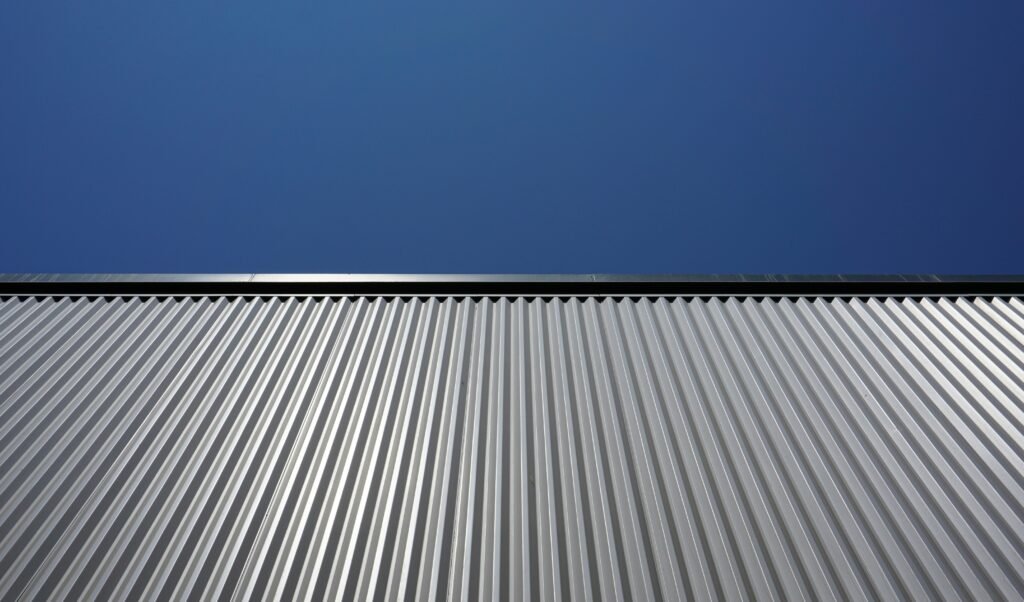
Corrugated and ribbed panels show repeating waves or ribs that cast strong highlights and shadows, with rib scale and spacing affecting how pronounced the texture appears from nearby sidewalks and from the street. The pattern typically follows the path of water flow, which ties the visual rhythm to the slope. System context centers on how the regular rib or wave continues through edges and turns so the texture reads as a coherent field. This family looks and feels different from standing seam, presenting a more visibly divided surface that changes character as the sun angle shifts.
Metal shingles and tile-like profiles
Metal shingles and tile-like profiles divide the roof into many smaller units that echo traditional coverings in scale and coursing. Stamped shingles can read as tight, rectilinear patterns, while tile-like formats show aligned curves or barrels that mimic clay or concrete forms. Finish and color influence how closely the resemblance tracks familiar non-metal roofs. In system context, emphasis moves from preserving long continuous lines to maintaining row alignment and pattern continuity at hips, valleys, and plane transitions, and the smaller unit size keeps texture visible even from ground level.
Horizontal, curved, and specialty profiles
Some metal roofs organize the surface with horizontal joints, smooth curves, or specialty patterns. Horizontal joints can make a slope read as subtly layered courses, while curved profiles appear on barrel vaults and arched features that bend in one or two directions. Specialty expressions include flat-seam grids and custom textures designed for a particular architectural effect. Here, the system discussion often focuses on whether the visible rhythm or curvature continues cleanly through edges and directional changes, because interruptions or misalignments can stand out on these visually defining forms.
Structural and architectural system context
Industry resources place steep-slope metal roofs in structural or architectural families to describe function within the building system. The same visible profile can belong to one family on a given structure and the other on a different structure, depending on how it is intended to work with the supporting elements. Profile describes what the roof looks like to the eye, while system context frames how that roof is meant to behave as part of a whole. Keeping both in view prevents reading too much into a single visible feature without understanding its role in the broader assembly.
Metal Roofing Material Families
Steel roofing
Steel is widely used for steep-slope roofs and commonly carries a factory-applied finish that sets color, sheen, and texture before forming. The metal holds crisp edges that can emphasize the clarity of standing seams or the definition of ribs and waves, and the finish often becomes a focal point of visual assessment at seams, edges, and locations where planes change direction. Weathering context for steel links finish chemistry and preparation with sunlight, wind, and airborne particulates, which is why industry materials discuss steel in terms of coatings and finishes rather than bare metal alone, without predicting a specific outcome on a particular project.
Aluminum roofing
Aluminum is also common on steep slopes and frequently arrives with painted, coil-applied finishes. From the street, aluminum and steel can look similar when finished in comparable colors and gloss, because profile defines texture and finish defines color. Discussions often note how the finish reads in strong sun or shade and how color uniformity appears across adjoining planes and through transitions. Aluminum shows up across the same profile families as steel, including standing seam, corrugated, and shingle-like formats, so naming both the shape and the metal provides the clearest description of what is present and how it appears.
Copper roofing
Copper is known for a visible evolution from bright metal through shades of brown and, in some exposures, toward green as a natural patina develops. It appears in standing seam, flat seam, shingle, and decorative stamped formats and is closely associated with historic buildings where its character suits the architecture. Discussions about copper often focus on the evenness of surface change, how planes that receive different sun or moisture exposure compare, and how transitions carry the material’s character around corners and along interfaces, with the understanding that the final color and timing of change depend on the specific environment.
Zinc roofing
Zinc develops a matte bluish-gray patina that softens reflectivity and gives the surface a uniform, low-gloss appearance over time. It is used in standing seam, flat seam, and specialty profiles and is typically left unpainted so the patina forms in place. Assessment centers on how shading, retained moisture, and orientation influence patina uniformity from one plane to another and around transitions, acknowledging that subtle differences are part of normal weathering and reflect exposure rather than establishing a condition on their own.
Coatings, finishes, and natural weathering
Many metal roofs rely on coil-applied finishes to set color and surface character before the metal is formed into panels or shingles, and those finishes include preparation, priming, and topcoating that are integral to product identity. Color, gloss, and texture interact with sun and local conditions in project-specific ways, which affects how the roof reads over time. Other roofs rely on natural weathering, with copper and zinc as familiar examples. Accurate descriptions pair the chosen profile with either an applied finish or expected patina, framing both how the surface looks today and the likely direction of change without presuming a singular path.
How Shape, Slope, and Transitions Affect the Conversation
Roof geometry and visible profile
Shape and slope set the canvas for any profile. A simple gable creates long, uninterrupted planes where standing seams can read as steady verticals, while hips introduce edges that change how patterns meet and turn. Dormers, intersecting slopes, and complex plan geometry add visual events that influence how the roof is read from the ground. The same profile on a steeper pitch can cast stronger highlights and shadows than on a milder one, and shingle-like patterns can read as tighter or looser depending on viewing distance and slope. These differences explain why two similar roofs can feel different in person.
Edges, valleys, wall interfaces, and parapets
Where the roof begins, ends, and changes direction draws the eye and defines system transitions. Lower edges, rakes, valleys, and interfaces at walls or parapets are prominent locations where pattern continuity and alignment affect how the surface reads. A standing seam that carries through a valley with consistent spacing looks different from one that changes rhythm, and corrugated ribs that approach a wall in one orientation read differently than ribs turning around a hip. Clear descriptions during assessment often call out these points of change because they reveal how geometry, profile, and material intersect in ways that shape what is visible from common vantage points.
Temperature movement and broad system behavior
Metal changes dimension with temperature, and longer panels make longitudinal change more noticeable at a general level, which is why industry references identify temperature-related movement as a core consideration. The choice of profile, the length of runs on each plane, and how those runs meet edges and transitions all contribute to how the roof reads as temperatures vary. It helps to understand that this behavior exists and that it is part of why professionals discuss metal roofing as a system with connected elements rather than as isolated pieces that behave independently.
Historic and architectural character
Metal roofing sits within a long architectural lineage that includes copper, galvanized corrugated iron, tin plate, terne plate, and zinc, with historic examples ranging from standing seam and flat seam to stamped decorative shingles tied to particular eras. On homes with historic character, the roof can define identity through pattern, seam spacing, and material choice, and on contemporary buildings the same materials and profiles can be used to express a different design intent. Recognizing this context helps frame discussions about appearance and which details matter most when aligning a roof with a building’s architectural story, especially where historic significance is part of the evaluation.
Metal Roofing and Weather or Energy Context
Wind, rain, snow, hail, and local exposure
Every roof sits in a specific environmental setting where sun, wind, rain, snow, hail, and airborne debris interact with its surfaces in different ways. Adjacent structures, orientation, and local topography can create distinct exposure patterns even along the same street. Profiles can reveal traces of how the setting is experienced, such as where water tracks along seams or ribs after a storm or how a patinating metal differs between sunlit and shaded planes. None of these observations alone determines condition or scope, but they offer context for how a particular roof experiences its environment over time.
Reflectance and thermal emittance
Reflectance and thermal emittance are defined surface properties used in energy discussions. Solar reflectance describes how strongly a surface reflects sunlight, while thermal emittance describes how efficiently a surface releases heat as thermal infrared radiation. Higher solar reflectance means less solar energy absorbed, and higher thermal emittance means faster release of stored heat once warmed. These concepts do not judge a particular roof on their own; they frame how finishes and colors influence interaction with sunlight and heat, which is why energy discussions tie claims to measured surface properties.
Color, surface temperature, and climate context
Color strongly influences solar reflectance and can shift surface temperature under clear sun, with light colors generally reflecting more sunlight than dark colors. Finish chemistry and texture also affect how a surface scatters and emits heat, so two roofs made of the same metal but finished differently can behave differently in the same climate. In hot, clear conditions, temperature differences between colors are more pronounced, while in cooler or overcast periods they may be less visible. Over the year, the local climate shapes how meaningful finish and color are to comfort or energy conversations, which limits broad generalizations.
Why environmental claims need project-specific context
Statements about metal roofs and environment remain incomplete without naming profile, finish, color, and climate. Energy-related behavior depends on measured surface properties and surroundings, and the same is true for weather discussions that reference wind, rain, snow, or hail. Two similar roofs can experience the same storm differently based on orientation and adjacent features. Claims are best weighed against the specifics of a building and its surfaces, using the actual roof characteristics and local setting rather than category-level assumptions that miss project reality.
What Metal Roofing Does Not Tell You by Itself
Current condition and remaining service context
The label metal roof does not reveal current condition or remaining service context. A roof with that label could be new or decades old, a long-panel standing seam or a shingle-like system, copper with patina or steel with a factory-applied finish, and none of those variables is disclosed by the category name. Industry guidance emphasizes that each roof exists within a particular set of circumstances, so reliable conversations about condition are anchored in details about profile, metal type, finish, geometry, and exposure, and in how the system is intended to function on the building.
Interior stains, moisture marks, and visible changes
Interior stains on ceilings, marks on walls, or visible changes on the roof surface are clues, not conclusions. A round stain could have multiple sources, and a streak on a metal panel could be normal weathering or something else. Without a qualified evaluation that considers the whole system and its interfaces with the building, such observations remain part of a larger picture. Treating visible changes as useful inputs, rather than as proof of cause or scope, keeps the conversation disciplined and increases the value of what can be documented from typical vantage points.
Storm events and roof-system scope
A storm can prompt questions, but the occurrence of a storm does not define whether or how a roof system was affected. Professional guidance frames post-event evaluation as determining whether the system experienced an external or extraordinary event and, if so, where those effects are evident. Two roofs under the same sky can experience the event differently, depending on exposure, geometry, and system context. The scope of any follow-up flows from what a qualified evaluation finds, not from assumptions based on a weather report or a single observation at one location.
Existing roof composition and project boundaries
Early in any project discussion, useful questions center on what the existing roof includes and where its boundaries lie. A general label does not disclose whether multiple assemblies or ages are present, how transitions are handled at edges or interfaces, or how the roof interacts visually with adjacent elements. It also does not define which areas fall within the scope of a conversation. Treating the roof as part of a larger set of building systems and describing profile, material, finish, geometry, and transitions together helps everyone share the same picture and understand assessment boundaries.
When to Seek Prompt Professional Attention
Active water entry or visibly displaced roof materials
Seek prompt professional attention if water is actively entering living spaces or if roof materials appear visibly displaced or out of place. Treat these observations as signals to define the situation and its boundaries with qualified help. Avoid linking a quick glance to a fixed conclusion about cause or scope. A professional assessment places what is seen within the system context of the roof and the building so that next steps are based on the way the assembly is intended to function rather than on assumptions.
Storm-related changes and unsafe conditions
After a significant weather event, engage a professional if you notice changes that suggest potential safety concerns or roof distress, such as elements that look newly shifted, out of alignment, or altered around skylights and parapets. The goal is to determine whether the system was affected and to outline the area of concern without presuming cause. Framing observations within profile, material, finish, and transitions helps keep the discussion specific to the roof in question.
Recurring stains, persistent odors, or suspected concealed moisture
If stains recur in the same locations, if musty odors persist near ceilings or walls, or if concealed moisture is suspected, consult a qualified professional. Treat these as prompts for evaluation rather than confirmations of a particular issue. A professional considers these signs within the roof’s profile, material, finish, geometry, transitions, and the building’s broader systems, allowing observations to be weighed alongside other context.
Extensive water damage, potentially contaminated water, or broad visible-growth context
If you encounter widespread water damage, water that appears potentially contaminated, or broad visible growth on surfaces, seek prompt professional attention. The priority is to understand extent and context safely and to plan appropriate next steps. Focus remains on defining which areas are involved and how building systems interact, rather than drawing conclusions from a single observation that does not account for the full system.
Questions to Ask During a Metal Roof Assessment
Which profile and material are present?
What is the visible profile on each roof plane, and is the metal identified as steel, aluminum, copper, or zinc?
If multiple profiles or materials appear on the same building, where are the boundaries between them, and how are they documented?
What type of finish is present on the metal surfaces, and is the roof relying on a factory-applied coating or on natural patina for its surface character?
Which roof-system components and boundaries are included?
Which roof planes, edges, valleys, wall interfaces, parapets, and roof-mounted elements are part of the system as evaluated?
Where do system boundaries begin and end on the building, including transitions to adjacent roofs or walls?
Are there areas with different materials, finishes, or ages that warrant being considered as distinct zones within the overall roof system?
How do shape, exposure, and adjacent elements affect the scope?
How do the roof’s shape and slope influence the way the profile reads and how the system behaves in local exposure?
Which roof planes see the most sun, wind, rain, snow, or hail, and how does that exposure appear in the visible surface?
How do adjacent walls, skylights, chimneys, or parapets interact with the roof profile in ways that shape the assessment scope?
What can be documented safely from indoors or ground level?
What photographs or notes can be captured from indoors or from the ground to support an assessment without accessing the roof?
Which interior or exterior vantage points offer clear views of edges, valleys, and interfaces for documentation purposes?
What reference information, such as dates of notable storms or changes in the building, can be compiled to accompany observations?
Frequently Asked Questions
What is the difference between standing seam and corrugated metal roofing?
Standing seam reads as long, continuous vertical lines with raised seams and smooth fields, producing a clean, ordered appearance that can emphasize height or slope. Corrugated presents repeating waves or ribs that create a textured surface with pronounced highlights and shadows. Both fall within the metal roofing family, yet they look different from the street and respond differently to light and viewing angle. Industry descriptions often treat standing seam as an uninterrupted linear surface and corrugated as a visibly divided pattern, placing each in a distinct system context for evaluation.
Is metal roofing only available in steel?
No. Common metals used for steep-slope metal roofing include steel, aluminum, copper, and zinc. Steel and aluminum typically carry factory-applied finishes that set color and gloss, while copper and zinc are often left unpainted to develop natural patina. Any of these metals can be formed into multiple profiles, so naming the profile and the material together provides clarity and avoids assumptions about appearance or weathering.
Can a metal roof look like shingles or tile?
Yes. Metal shingles and tile-like profiles use many small formed units to resemble familiar roof coverings, from coursed shingles to curved tile shapes. From a distance they read as patterned fields with shadows similar to non-metal counterparts, and up close the metal’s finish sets surface character. Because they use small units, these formats emphasize row alignment and pattern continuity across hips and valleys.
What is the difference between metal roofing and a cool roof?
Metal roofing describes roof coverings made from metals such as steel, aluminum, copper, and zinc in profiles like standing seam, corrugated, and shingle-like forms. A cool roof refers to a surface with defined energy-related properties, particularly higher solar reflectance and often higher thermal emittance. A given metal roof can qualify as cool if its finish and color provide those measured properties. One term describes material and profile, the other describes measured interaction with sunlight and heat.
Can a metal roof be used on more than one roof shape?
Yes. Metal roofing appears on simple and complex geometries, including gables, hips, dormers, parapets, and curved forms. Certain profiles are often associated with particular architectural expressions, yet metal can be shaped to suit many conditions. How a profile reads across different shapes and through transitions is part of the system context professionals consider when describing what is present and how it appears.
Do stains or a storm event identify the source or scope of a roof problem?
Not by themselves. Interior stains, visible surface changes, or the fact that a storm occurred do not establish source or scope. Industry guidance emphasizes that each roof system has unique circumstances and that evaluation focuses on whether and how the system was affected. Reliable conclusions come from a qualified, whole-system approach that considers profile, material, finish, geometry, transitions, and exposure.
The Bottom Line
Metal roofing is a wide family of coverings that includes distinct profiles and multiple material types. It can appear as standing seams that read as long vertical lines, as corrugated or ribbed textures with repeating waves, as shingle-like or tile-mimicking units, and as horizontal, curved, or specialty forms. It is formed from steel, aluminum, copper, and zinc, with some roofs relying on applied finishes for color and others relying on natural patina for an evolving appearance. A single label cannot capture this variety.
Useful conversations name the profile and the material separately and place them within the roof’s shape and its transitions to adjacent elements. What is visible from the street belongs to a connected system that includes edges, valleys, interfaces with walls and parapets, and roof-mounted features. The roof also sits in a real environment that includes wind, rain, snow, hail, sunlight, and airborne matter. Energy terms such as solar reflectance and thermal emittance describe how a surface interacts with heat and light, and those properties depend on finish and color as well as on local climate.
Visible clues help, yet they are not conclusions. Interior stains, shifts in surface appearance, or the occurrence of a storm do not establish source, condition, or scope on their own. Industry guidance frames evaluation as a project-specific process that looks at the whole system and its context and that treats boundaries and transitions as part of the story. Prompt professional attention is appropriate when immediate concerns arise or when observations suggest potential safety issues, so that findings can be anchored in how the system is intended to function.
In short, metal roofing is not a single product category. It is a set of profiles, materials, finishes, and system forms that come together on a particular building. Profile, material, geometry, exposure, and transitions shape the conversation, and a qualified, whole-system assessment adds the project-specific clarity that no single term or symptom can provide on its own.
Also Read: